
How I'm Rebuilding My Cardio Post-COVID
I’ve been able to successfully maintain zone 2 cardio with my dysautonomia management strategies. Here’s the magic sauce of how I’m doing this!
Keep in mind, this is my journey and doesn’t mean it will work exactly the same for you.
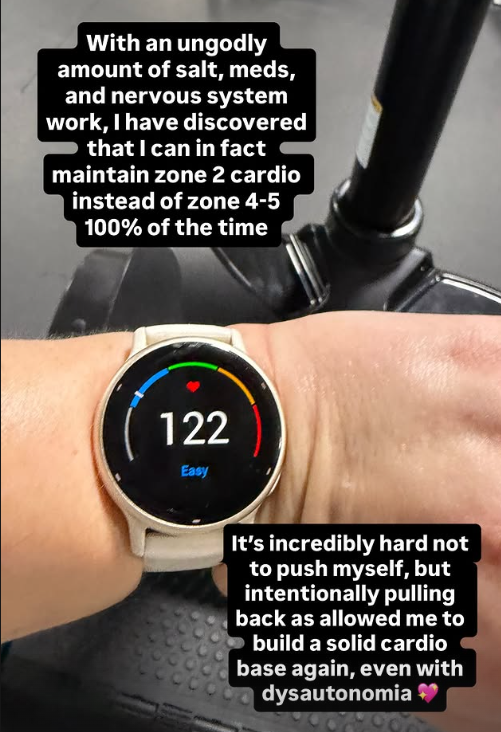
Heart rate zones can be calculated with your resting heart rate and age. In general, it involves low intensity work on your heart. This helps with improving your heart health and mitochondrial density (energy!). High intensity cardio is also important for heart health, but if you’re spending 100% of your time doing high intensity cardio, even by just existing thanks to dysautonomia, then that’s a recipe for becoming burnt out.
This has been a 5 year journey for me since my cardio suddenly vanished post-covid. Time is the first factor that’s allowed improvement, but here are other things I’ve focused on.
I’m an advocate for both western and holistic medicine. Even though I never had a tilt table test, my doc is treating me as if I have POTS. She has me on a low dose beta blocker which has been really helpful for me in the mornings. Some hate this med because it drops their heart rate too low, so it’s not for everyone. I’ve also recently changed up my mental health medications which have helped me be more regulated in general. It’s okay if you also need psych meds like me. It’s not a fix all, but definitely takes the edge off and gives me more motivation to do what I need to take care of myself.
I knew I needed more salt but didn’t realize how much I needed to feel good. I’ve been taking Redmond Re-Lyte first thing in the mornings. 4000-5000mg sodium works best for me daily, but food does also count toward this. I know I’ve had too much if I’m feeling puffy and swollen.
Everyone wants a regulated nervous system but no one tells you what this even means. It’s ultimately a really broad term that includes decreasing stressors, histamine load, and spending less time in flight or fight. Finding why your nervous system is in overload is the first step. What’s helped me is psych meds to reduce overall nervous system overload due to sensory sensitivity and intentionally spending time doing things that bring me joy. For me, this looks like becoming self employed, spending time with animals, spending time outside, intentional breathwork, and decreasing stressors that I’m able to control.
Blood sugar regulation has been a big one for me! My medication management seems to be impacting this, but I use the Stelo over the counter continuous blood glucose monitor to make sure I’m not spiking; and therefore, dropping my blood sugar too low. I’ve dealt with reactive hypoglycemia throughout my life which causes this to happen, secondary to my dysautonomia. Eating lower carb, very high protein, and very high fiber, + fat has helped me. I intentionally seek out full fat options to slow my digestion. Some with hypermobility have the opposite problem of me, so don’t forget this is just what is working for me. I recommend working with a dietitian for this.
Movement has been a consistent thing throughout my life and even through my recovery. Even though it looks different for me than it used to, I’ve always aimed to do some form of intentional movement, even just breathwork! I aim for strengthening 2-3x/week and have been working toward zone 2 cardio 3-4x per week. I started with 5-10 minutes and am up to 30-45 min now. This started as walking on the treadmill where I could control the speed and incline to see my heart rate response.
Ultimately, there are a million changing factors that help us with this. Start with choosing 1 and intentionally working on it for 6-8 weeks. This will take you a long way! And as always, we’re here to support you through this process.
Did you find something here that helped you on your own hypermobility journey? Join our mailing list to get tips like these delivered straight to your inbox every Wednesday!
Blog posts may contain affiliate links to products mentioned. Purchasing through these links helps support Jenna’s work - she may receive commission at no extra cost to you.